Harry and Josephine Rubens House | Sheridan Road, Glencoe, IL | Built in 1903, Demolished 1960
The Harry and Josephine Rubens house, built in Glencoe, Illinois in 1903, is generally regarded as one of Maher’s most idiosyncratic (and to some, most inscrutable) buildings. It was designed for clients who apparently permitted Maher to follow his passions, allowing him the opportunity to create his ideal example of what he would call “indigenous architecture”.
Maher was one of several architects in the early 20th Century that worked toward an architecture unique to the United States that was to be distinct from anything that preceded it anywhere else. Henry M. Hyde, in a September 12,1913 article that appeared in the Chicago Tribune entitled “Rebels of West Shatter Styles of Architecture”, recognized the work of Maher and of the other members of “the new American School of Architecture”, by observing that “They pay no attention to the conventions and rules of the classic types of architecture. They would express a new and democratic spirit.” He continued “…there is no doubt that just now the Chicago insurgents and their work is attracting more attention and causing more comment than any other architectural development in America”. Maher had made this claim for the Rubens house in an article that he wrote that appeared in the June, 1911 edition of Arts and Decoration, where he had noted specifically in his design for the house that “No effort has been made to reproduce in any respect a former architecture, therefore it becomes impossible to form any comparison of merit from the standards of past designs. The house is its own precedent”.
In 1908 the Chicago Tribune observed that in Glencoe, “While its homes are not as a rule pretentious as those at Lake Forest and Highland Park, particularly as regards the size of the grounds, yet it has some that are as beautiful and artistically developed as any along the entire North Shore. This may be said of the home of Harry Rubens on Sheridan Road, South Avenue and the lake. It is about nine or ten acres in extent with a fine natural forest, in addition to many planted trees, while among its developed features are electric fountains, artificial waterfalls and fish pond, with exceedingly handsome stables and lodge. His house, a handsome brick and stucco structure, has a most commanding location overlooking the lake, and altogether his home probably represents an investment of about $250,000.”
Still, not everyone was enthralled. In a piece called “The Architecture of Ideas” by the critic Arthur C. David that appeared in Architectural Record in April, 1904, the author gives us his opinion of Maher’s magnum opus: “Finally we come to the house of Mr. Rubens, at Glencoe, Illinois, designed also by Mr. Maher—in which it must be straightaway admitted that the architecture of ideas goes to seed. … Why anything and everything? Doubtless, some reasons may be alleged for these perverse dispositions, for this is an architecture of ideas, and Mr. Maher has evidently put plenty of them in this design; but in this instance, at least, the appearance of the building is devoid of architectural reason or propriety. The architect has broken away from the safe [!, my punctuation] method of designing a good solid block of a house with plain, honest walls, and has attempted to construct some kind of a decorative scheme. The result is simply grotesque”. Obviously, David was not a fan; in the same article he described Maher’s Patten house in Evanston as “ugly and clumsy in appearance”. (Others may not have felt the same way; Patten died in 1928 and the house was donated to Northwestern University by his children after his wife’s death in 1935, with the understanding between the two parties that the house would be used “as a memorial to their mother”. With a promise to use the money from the sale of the house to create a scholarship endowment in honor of Amanda Patten, Northwestern put the house on the market in 1936 for $65,000 [it had reputedly cost $500,00 to build] and it was demolished in 1938. At an auction in 2006 a single window from the house was sold for the rather impressive sum of $120,000 [or about $192,000 today]. The window and much of the interior decoration of the house which David had so deplored was designed by Louis J. Millet, who founded the Art Institute’s Department of Decorative Arts and Design and who had designed the skylight at the Ryerson Library there. In 1902-3 he was the chief of mural and decorative painting for the St. Louis World’s Fair, and later provided Louis Sullivan with designs for the interiors for some of Sullivan’s later commissions.)
H.D.C. (Herbert C. Croly), in the article “What is Indigenous Architecture” that appeared in the June, 1907 edition of Architectural Record, was more sympathetic (sort of) in lamenting that that the average American didn’t have the aesthetic sophistication that would allow “Indigenous” architecture to be established in this country, although he, too, felt in this instance that Maher might have been catering more to his own taste with the money of indulgent clients than he was considering the wishes of the clients themselves.
On the other hand, from an unapologetic admirer (the New York architect Aymar Embury II) in 1909: “Anyone who desires their architecture undiluted by the personality of the architect, will pronounce this house bad beyond redemption, but to those who see the brilliancy and daring of its author, it will be full of interest. It is so different, so unusual, that a proper viewpoint from which to judge it is impossible to find, and whether the immense cleverness displayed in its design is sufficient to atone for its disregard of the most elementary consideration of both form and scale, is something which time alone can tell.”
Such was and continues to be the tone of expression of many contemporary critics of avant garde art and literature. Although it never served as an archetype as Maher may have liked it to have it been, as frequently happens, time has a way of “healing all wounds”, and it would be interesting to know how Rubens’ house would be regarded today if it was still standing so that it could be looked at as a 3D object. Remember that the Eiffel Tower, erected for the World Fair of 1889, in its time was considered “useless and monstrous” and a candidate for demolition but eventually become the much-loved symbol of Paris. And as for our Mr. David on the other hand, he has become more-or-less a footnote to history.
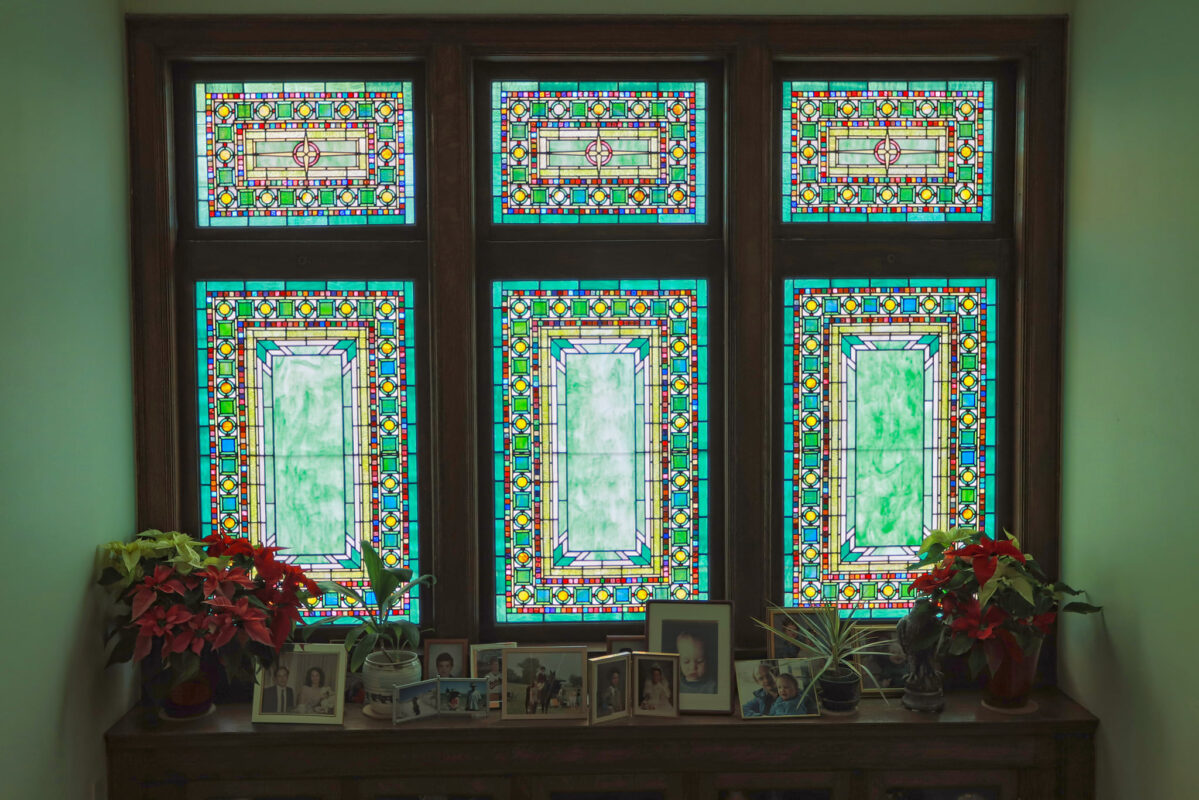
Items that were designed by Maher or designed for some of his buildings and taken from them over the years can be found in the collections of various museums across the country. These include the Milwaukee Art Museum, The Metropolitan Museum of Art in New York, The Cooper-Hewitt Museum in New York, The Museum of Fine Arts in Boston, The Art Institute of Chicago, and the Chicago History Museum. Maher-designed lighting fixtures, mosaics, stained-glass windows, and andirons may very well have been salvaged from the Rubens house either at the time it was remodeled or was torn down, but where they might be now is a mystery for another day.
As we have touched on here, the Rubens house has been the subject of much publicity over the years. That our subject may have been generally regarded in its time as more of a curiosity than as a harbinger can best be illustrated by what happened to it after Harry and Josephine Rubens sold the house in 1911, which we’ll touch on shortly. As Croly observed in 1907, “The house that is designed to suit the merely individual traits either of an architect or an owner will not in its interest outlast the life of the individual.” Prophetic, indeed.
In the meantime:
Harry Rubens was born in Vienna, Austria, on July 7, 1850 and arrived in the United States in 1867after graduating from the Polytechnic school in Vienna. He first located in St. Louis, Missouri, where he worked as a newspaper editor, relocating to Chicago in 1873. There he continued his journalism career as local editor of the German language newspaper, the Chicago Freie Presse, and also worked for the Chicago Times and the Evening Mail while studying law, passing the bar in 1877. Two years later and until 1885, he was a member and president of the board of the Chicago Public Library, during which time he developed and implemented the idea of branch libraries.
Rubens would become a senior partner at the law firm of Rubens, Fischer, Mosser & Rigby (the firm existed under different names at different times with other partners), and a director of the Central Trust Company of Illinois (its president Charles G. Dawes “enjoyed a reputation from Boston to San Francisco” and was among other things a lawyer, utilities magnate, Nobel Peace Prize winner and vice-president under Calvin Coolidge. His mansion at 225 Greenwood St. in Evanston is a house museum owned by the Evanston History Center since 2009. It’s worth a visit.). Rubens was corporation counsel for the City of Chicago in 1884 and 1895, and it was during the later tenure that Rubens succeeded in initiating a program to eliminate grade crossings by raising railroad track at key points throughout the city. In 1898 he organized United Breweries Co., a consortium of small breweries that were located in the Illinois communities of Chicago, Blue Island, Joliet and Danville which were consolidated into a single entity.
Despite what his conservative profession might suggest, Rubens in his younger days was a member of the Socialist Labor party, and under that banner ran for the position of corporation council for the City of Chicago in 1879 (he didn’t win). The Socialists at that time attracted immigrants and working-class workers, urban reformers, feminists, middle-class intellectuals and socially conscious millionaires. Rubens later became involved with the Democratic Party, was active in the Waubansee Club, and served several times as a delegate at Democratic national conventions. This liberal way of looking at the world may have been one of the reasons that Rubens became attracted to George Maher’s unconventional architectural philosophy, and allowed Maher to have his way with the design of the buildings at Rubens’ estate in Glencoe in an era when the architects of Rubens’ wealthy colleagues tended to present them with more traditionally-designed homes (think David Adler and Howard VanDoren Shaw).
Harry married Josephine Diedeck in 1876, and they would have three children together. Josephine Diedeck was born in Vienna on February 29, 1852 and arrived in the United States in 1875. Their children were: Hertha, who married Edwin J. Mosser, an attorney; Ann, who married Emil W. Wagner, a prominent grain merchant; and Harry Rubens, Jr., who married Dorothea Pullenberg, whose parents had immigrated from Germany. Harry Jr. for a time as an attorney was associated with his father but would later move to Seattle to be near his wife’s family, where he continued his practice until his death. Hertha Rubens Mosser was the president of the Lutheran Woman’s League of Chicago; that organization was responsible in 1925 for building the Children’s Receiving Home (now K. Lightford Recreation Center operated by the Maywood Park District) at 809 S. Madison St. in Maywood Illinois, at a reputed cost of $100,000.
The Rubens’ lived at various locations around the city, including in a townhouse on Clark Street in Chicago, at a house on Deerpath Road in Lake Forest, IL (where they lived with their Irish maid, Swedish cook, and the coachman, who was born in Wisconsin). In 1893 Rubens built the Majestic Apartment House, a luxury mixed-use building which was located at the southwest corner of Rush Street and Walton Place on Chicago’s north side. It was an eight-story structure designed by the architect Edmund R. Krause; Krause had designed Blue Island’s village hall in 1891 and in 1906 would design the Majestic Theater Building (now CIBC Theatre) at18 W. Monroe in Chicago’s Loop. Rubens and his first wife Josephine and his second wife Ida would maintain an apartment at the Majestic Apartments at least until Harry Rubens’ passing in 1920, as the Glencoe house was only a “summer” home for them. The Majestic House was torn down in 2004 and replaced by the Elysian (now Waldorf Astoria) Hotel.
Entrance to the Majestic Apartment House
Josephine died on July 15, 1912, and two years later Harry married Ida (maiden name unknown), who was born in Munich, Germany on September 4, 1866 and arrived in the United States aboard the Mauretania with her husband in September of 1914. Harry Rubens died on June 5, 1920 and he and Josephine are buried at Graceland Cemetery in Chicago. Ida lasted a bit longer; she passed away on October 21,1960 in Balzano, Italy, and her cremated remains were interred at Wurzburg Cemetery in her native Germany.
PREPARING TO BUILD THE HOUSE AND STABLES, AND LANDSCAPING THE GROUNDS
In October of 1902, Rubens purchased for $32,500 a seven-acre property on Sheridan Road and South Street that included 250’ of frontage on Lake Michigan, where he expected to build his house for $50,000 the following spring. Immediately following the purchase of the property Rubens petitioned the Village of Glencoe to relocate South Street, a deal which was effected in August of 1904 with the promise that Rubens would give “bonds to pave the street with macadam, and not to obstruct his neighbor’s view of the lake with trees”, giving Rubens a total of about nine acres for his estate. It is reported at this time that “work on the house will begin at once”, although it was probably well under way by then as the house was published in April of 1904.
The “motif-rhythm” theme for the house was the hollyhock, and the grounds were designed by the prominent landscape architect Jens Jensen. Jensen had worked on the project between 1903-1906 within a timeframe that allowed him to express his mature style; he planted ninety-five percent of the property with species that grew wild within a mile of the house. In her 1910 ode to the north side of Chicago and the northern suburbs, Book of the North Shore, Marion White waxes rhapsodic over the Rubens’ house and grounds:
“There are now many handsome residences in Glencoe, as well as finely kept thoroughfares. Among the most striking of these homes is that of Mr. Harry Rubens. It is so unique that it is worth writing about. It stands in the midst of the most lovely park acreage the writer has seen, outside of Old England. You have to literally find the house, and the safer plan is to keep to the broad driveway after you enter the stone gateway, with its clock that chimes musically for the benefit of all Glencoe. You twist and turn, and become lost in the wonder of the parklike grounds. Then you are conscious of approaching a structure in keeping with what you have already seen. But there is the lily pond, like a jewel in a setting! Hemlock, whispering pines, trees of every variety, and the most brilliant bank of scarlet salvias, while, beyond, a vista of green and undulating surface, in which the native growth has been encouraged, is the Lake, which on that particular day, looked like a glimpse of the Rhine. Old Lake Michigan has many moods, and, on occasion, it can assume the aspect of any of the most famous and lovely waters of the world.”
In its day, the house must have hosted many notable guests, which in 1909 included a “brilliant party” attended by the foreign consuls of Chicago and their wives “… given … by Harry Rubens at his home in Glencoe in celebration of the seventy-ninth natal day of Franz Josef, the Emperor of Austria…Toasts will be answered in the language of each country represented, Mr. Rubens acting as Toastmaster”.
For all they had invested in it, the Rubens’ kept the house only until the spring of 1911, at which time it was purchased by the family of James Simpson, who was the general manager and later president of Marshall Field & Co. Simpson likely chose the house for its location, the size of the property, and for what Jensen had done to it, as he once noted “I shall not allow any showy geraniums or other foreign flowers to spoil the composition made for the previous owner of my place.”
The Simpsons expanded and remodeled the house as we see here, and in doing so completely removed any vestige of Maher’s design. An article that appeared in 1960 in the Chicago Tribune at the time the house was to be demolished completely ignored its original appearance and the architect who created it (or, to be fair, may have been oblivious to these details), referring to the house as “a North Shore landmark of turn-of-the-century elegance” and “a Colonial Georgian jewel of a home”. Although one could see by a careful examination of the two different treatments that while for the most part the various features of the façade remained in their original positions, it would be easy to forgive someone for thinking after the transformation that they were looking at a different house.
James Simpson died 1939 and his wife and son followed him in 1959. Nothing of Jensen’s plan remains today, as the estate was sold to a developer who divided it into 11 building lots, obliterating it all.
IN THE IMAGES THAT FOLLOW, WE’LL ALLOW THE DESIGN OF THE HOUSE TO SPEAK FOR ITSELF…
Click to enlarge and view the full image
The following are taken from the January, 1907 edition of Architectural Record
The following are from the Architectural Record, April 1904